The minerals
72 critical minerals across 10 government lists from the US, Europe and Asia — where they're mined, how concentrated supply is, which are running short, and why each one matters for the AI buildout.
Every critical mineral, at a glance
Each tile is a mineral or material named on at least one national critical list. Recolor the wall to see what matters, what's short and who agrees.
20 minerals are in deficit or under strain right now
Structural deficits are projected by the IEA; 'tight' markets are facing export controls, price spikes or active disruption as of October 2026.
Copper
DeficitThe metal of electrification. Copper wires the grid, the substation, the busbar and the chip — and it is the single largest mineral input to AI infrastructure.
Cobalt
DeficitA battery cathode and superalloy metal. About three-quarters of mined supply comes from the Democratic Republic of the Congo.
Lithium
DeficitThe lightest metal and the heart of every lithium-ion battery — from phones and EVs to the grid-scale storage now being bolted onto data centers.
Gallium
TightA by-product of aluminum refining that becomes gallium nitride (GaN) and gallium arsenide (GaAs) — the materials of power electronics, RF chips and lasers.
Indium
TightA soft by-product metal used in touchscreens (ITO) and in indium phosphide — the compound semiconductor behind many high-speed optical lasers.
Tungsten
TightThe densest common metal with the highest melting point — used for cutting tools, armor, and as the 'plugs' that connect chip transistors to wiring.
Germanium
TightA semiconductor metal recovered from zinc and coal ash, essential for fiber-optic cores, infrared optics and high-speed SiGe chips.
Electrical Steel (GOES)
TightGrain-oriented electrical steel forms the magnetic cores of power transformers — a chronic bottleneck in grid build-out. Listed by the US DOE as a critical material.
Helium
TightAn irreplaceable inert gas recovered from natural gas, used in chip fabs, MRI scanners, fiber-optic drawing and leak detection.
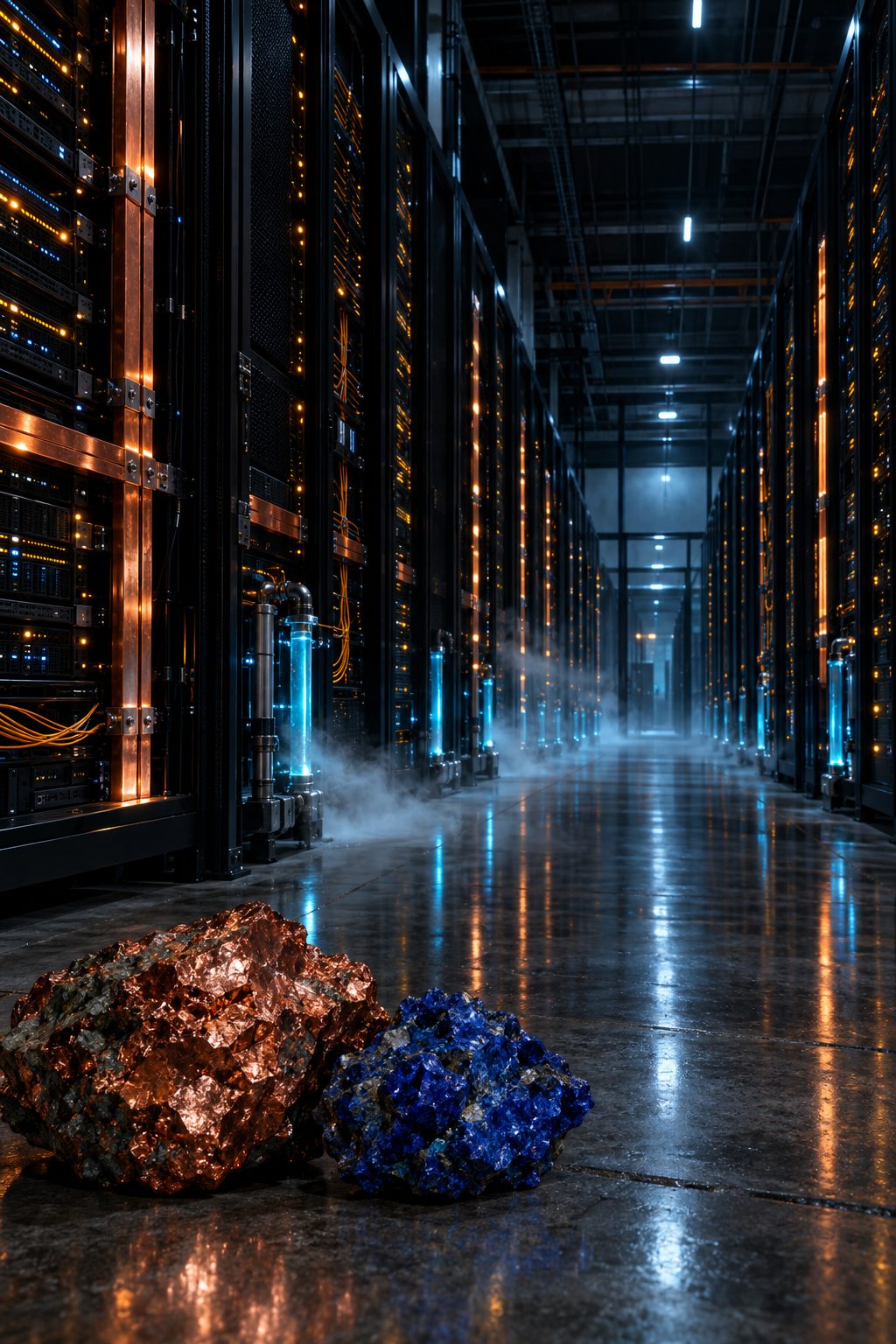
An AI data center is a mine you can't see.
A 2026 model of AI data-center build-out found copper alone is roughly 82–83% of the mineral mass — mostly in the grid that feeds the campus. The scarcest risks sit in tiny quantities: gallium, germanium, indium and hafnium inside the chips and optics.
Explore the AI mineral stackWhere supply concentrates
Shaded by the number of tracked minerals for which each country is the world's #1 producer (USGS 2025 estimates). 15 countries hold a top spot; China holds 23.
What changed recently
Know when the map moves.
New export controls, list revisions, price shocks and AI-demand signals — summarized and sourced.